Thursday, March 26, 2015

Hundred Book Challenge #21: "Portnoy's Complaint" by Philip Roth

“Portnoy’s Complaint” has been called one of the dirtiest books ever written. I don’t know if I buy that. Not just because I’m still smelling the stink of “The Naked Lunch” but because “Portnoy’s Complaint,” while it does reel with explicit scenes, isn’t really about sex or sexuality- and the scenes are far from sexy.


To quote The Beatles, it’s a dirty story of a dirty man. A sad story of a sad man. A repressed story of a repressed man. For all its explicitness it’s a sad and lonely book.

Told as a monologue to a therapist, this book is an attempt to tell the story of a repressed Jew during the sexual revolution of the 60s. Using sex as a story telling tool, it explores the themes of America. What it means to be American and what it means to live in America as an outsider.

Take, for instance, this quote:

“Don’t tell me we’re just as good as anybody else, don’t tell me we’re Americans just like they are. No, no, these blond-haired Christians are the legitimate residents and owners of this place and they can pump any song they want into the streets and no one is going to stop them either.”

Or this:

“Shame and shame and shame and shame- every place I turn something else to be ashamed of.”

It’s a book aching with truth. Much like the graphic novel “Maus” by Art Spiegelman, the book also looks at the generation of Jewish people living in the shadow of their parents post WWII. Because that generation had to deal with the Nazis they have an automatic superiority that doesn’t necessarily match up with their own personalities or lifestyles. It all gels together nicely and humorously into a story about a man who rebels against his parents even while being completely controlled by them. He is desperate to be a “real” American while hating America. He wants to understand Judaism but the only god he worships is Freud.

I say humorously cautiously. It is a funny book but it’s a dark and sad funny.

His inability to come to terms with his own Jewishness crescendos in a section that sums up the tone of the book quite well. Throughout the book, Portnoy says he has sex with women not to get physical pleasure but to try and be a part of their whole lifestyle and history. In other words, to become more American. Near the end of the book he travels to Israel and tries to have sex with an Israeli activist but finds himself impotent.

Get it?  

Moving on. I’ve finished reading “Money” and have started reading “The Man Who Loved Children” and “To the Lighthouse.”


Thursday, March 12, 2015

Terry Pratchett.

One of the brightest literary minds died today. I am sad but also I am reminded of the joy he brought into my life. 
I wrote this back in 2013 It obviously still holds true. 
I can't bring myself to write more about it now other than to say: I think the best gift you can give someone is a Terry Pratchett book. If it's their first they are in for a lifetime of joy. If it's not their first they want another. 


Vacation to Terry Pratchett's Literary Discworld

(originally published Sept 8, 2013)


I know times can be tough and funds can get low. I also know many people schlepped through the summer, always with the thought of a theoretical vacation taking place in the future when they had a bit of spare scratch -- plans that never came to fruition.
Well, the cheapest form of a vacation is to read, and boy oh boy, do I have some books for you.
If you don't know who Terry Pratchett is, I honestly feel bad for you. The sheer amount of joy Pratchett has brought into my life, and into the lives of his readers, can't be measured.
Pratchett is a British writer best known for his ponderously huge Discworld series. If you want a good vacation from everyday life, read some Discworld books.
What is the Discworld? It's a world of magic and it's in the shape of a disc. It sits on the back of four elephants that stand on the back of a giant turtle that flies through space. A more accurate definition of Discworld may be that it's a space for Pratchett to riff on the human experience. The Discworld stories are funny, thrilling, interesting, poignant, touching, nostalgic and biting. They're the kind of books that punch you in the stomach and then lay you down on the couch with a bowl of ice cream while telling you how lucky you were that the punch wasn't a few inches lower.
They're hard to explain, other than I am pretty sure anyone who reads them will find something to love.
There are more than 40 Discworld books out there. While some fans, me included, have built complex charts to show how each book interacts with the rest in some sort of coherent time line, you are safe to just pick one up and start reading.
I started to write out some of the basic tenets of these stories before realizing how impossible that would be in the space provided. For example, one book, entitled "Witches Abroad," explores the role of fairy tales in modern life, talks about the power of stories, pokes fun at elderly folk going on vacation, makes fun of the culture of Louisiana and provides an insightful look at the economic effects of colonialism.
Apart from all this though, and what makes Pratchet's Discworld books especially good for taking a vacation with, is the fact that these books transcend what any reasonable person can expect from a story shelved in the humorous fantasy section.
They are funny books, hilarious in fact. Unlike a lot of funny writers though, these books have amazing stories that stick with you. Everything I just wrote about "Witches Abroad" is true, but it wasn't what I was thinking about while I read it. While I was reading it, I was totally sucked into the world and living right along with the characters.
The more I write here the more I realize how hard it is to categorically say why these books are so good. Let me put it to you this way: I read a lot of books. I have close to a literal ton of books sitting in my home that I've read and another ton of books I'm planning on reading. I've read fantasy series and detective stories and westerns and science fiction and literary fiction and classic literature and French literature and British literature and Russian literature and experimental literature and on and on and on.
Never have I gotten so much pure joy and literary elation as I get from Terry Pratchett's Discworld books.
So go find some and start reading.


Hundred Book Challenge #20: “Slaughterhouse-Five” by Kurt Vonnegut

World War II sort of hangs over most modern US history and literature. If it’s not the outright point of the story it hides in the background, visible only to those who like to pick through the tall grass.


Slaughterhouse-Five is the most unusual WWII book I've ever read. It’s funny but not celebratory. It’s touching, even sad, but not romantic. It’s honest but has aliens that look like plungers.

Billy Pilgrim is unstuck from time and as such lives random moments of his life over and over again. The narrator of the story, Kurt Vonnegut one assumes, tells his story as best he can.

Like other WWII writers, Vonnegut’s language is simple. He is very economical with words and as such the entire thing is tiny (especially when compared to some of the other books on this list). This simplicity, when mixed with the horror of the firebombing of Dresden, has a scorching, purifying result.

To be honest, I finished reading this book a couple weeks ago and it’s been on my mind ever since and I’m still not sure what to say about it. For all its simplicity of language it’s pretty saturated.
I think it has something to say about PTSD- living out of time is a pretty good descriptor of that I think. It has something to say about war- a seemingly simple message that war is wrong and soldiers aren’t the heroes we tend to make them. Take this quote:
“I have told my sons that they are not under any circumstances to take part in massacres, and that the news of massacres of enemies is not to fill them with satisfaction or glee.”
It also seems to be about the very nature of stories. The things happening are not happening to the narrator, but he was there at some of them as he points out a few times in moments of unsettling clarity: 
“That was I. That was me. That was the author of this book.” 
The fact that Vonnegut was actually a prisoner of war held underground in Dresden during the bombing becomes almost like a ghost in this story.

The bombing of Dresden is interesting in and of itself. The allied bombing of a German city with of no military purpose but with significant cultural value becomes the epitome of mindless war.
Again, from the book:
“There are almost no characters in this story, and almost no dramatic confrontations, because most of the people in it are so sick and so much the listless playthings of enormous forces. One of the main effects of war, after all, is that people are discouraged from being characters.”
And that is pretty much it. This makes the whole abducted by aliens who teach Billy the truth about time more of a somber realization than a fantastical story element.

OK! Coming up next. I just finished “Portnoy’s Complaint” and will write about it soon. I’m about halfway through “Money” and just started “To the Lighthouse.” I also decided to give up on the Top Ten concept for these posts. It seemed artificial.


Also, we reached number 20 on the list! 1/5th of the way through!

Thursday, February 12, 2015

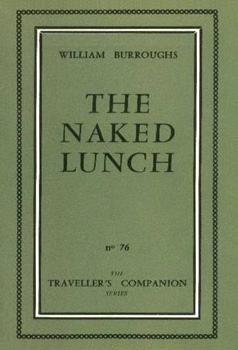
Hundred Book Challenge #19: "The Naked Lunch" by William Burroughs.

There. I did it. Now I never have to do it again.
Ten thoughts on The Naked Lunch


10. I don’t like it. Maybe I’m too old, too square or just too normal to really get it but I didn’t enjoy reading this book at all. It was an assault on my intellect- not because it’s perverse but because it’s perverse with no larger goal. I have to imagine that the obvious and over-the-top societal winks aren’t the reason this book is considered great. Maybe I’m missing the elephant in the room or maybe it’s a case of no one wanting to tell the emperor he has no clothes.
9. It’s simplistic. I admit that it probably had a point when it first came out. It was a landmark case against censorship when it came out so that’s something to be grateful for. If something smashes through a wall it’s probably not going to be a pretty, delicate thing, but this is just silly. Every number is 69. Everything is described as erect, quivering, ejaculatory. Every little boy is masturbating on a wooden bench (the same wooden bench?). Everyone is pissing and shitting as they roll naked down a mountain of filth. Just read these last few sentences over and over to get the gist of this story.
8. The larger point: Where is it? The story is, by design, segmented and scattered. Characters transform into other characters and sentences trail off. Overall there is a theme of three civilizations, or just cities. Freeland, run by Islam Inc and acts as sort of a limbo; The Interzone where there are a bunch of really raunchy parties; and Anixia which is like totalitarian Texas. I think. A guy is trying to get his next drug fix and others are doing other things.
I say where is the larger point because others have been more subversive books that had a point to it all. “Fear and Loathing in Las Vegas” comes to mind. This is just shock for shock- or maybe not even that. Maybe it’s just a guy writing whatever filth drips from his drug-addled mind.
7. The experience reading this was new, at least. When I stopped looking for a plot, point or reason for existence, I found myself reading purely for the sensation the words plant on my mind. This was novel and would have been enjoyable if the words were something more substantial than what would pass as a seventh grader’s attempt at shock.
6. It’s a good thing more people don’t know about this book. With the uproar “Fifty Shades of Gray” is making I can only imagine what hubbub this book would cause. Did cause. Whatever. I’m stretching here to think of 10 interesting things to say about this.
5. Ok, here’s one: There were some funny parts. A man with a talking asshole which eventually took over the man. That bit made me laugh a bit.
4. I read the “restored text” which included a lengthy explanation as to how the book was written and named. It was far more interesting than the actual book. Also included were Burroughs’ notes on what it feels like to take every drug you can imagine. That wasn’t nearly as interesting as I thought it would be. 
3. I’m just going to go ahead and say William S. Burroughs was a stupid. He was the heir to an adding machine fortune and he just drugged around and then wrote a very stupid book.
2. I don’t have anything else to say it was dumb.
1. And it’s over.


Coming up: Slaughterhouse Five and Portnoy’s Complaint.

Monday, January 26, 2015

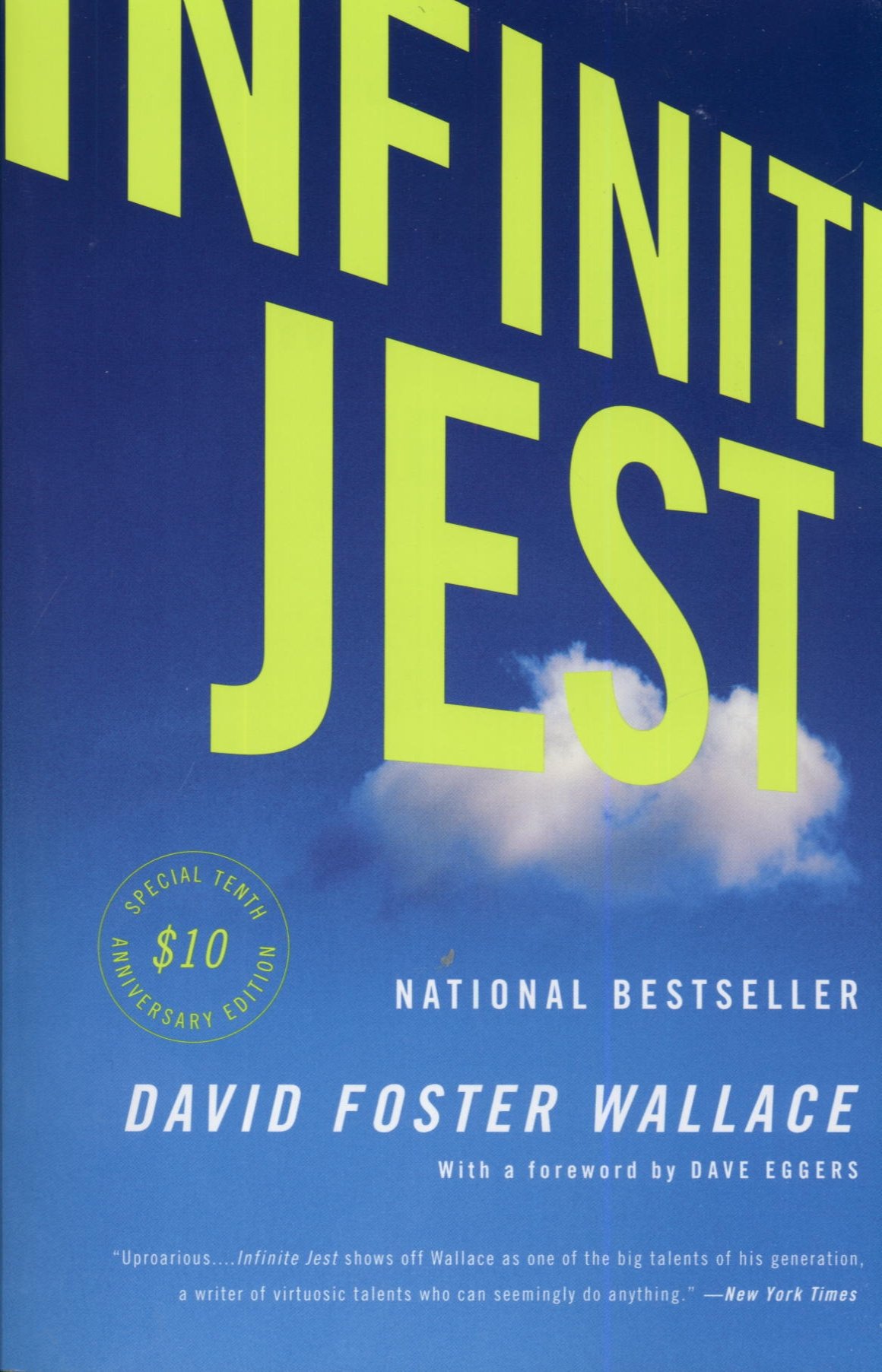
Hundred Book Challenge #18: "Infinite Jest" by David Foster Wallace

So I had ten thoughts for nearly every sentence in “Infinite Jest” but I’ll see what I can do where to keep it down to just ten total. 


1. I don’t understand it. I think I do a bit but not enough. There is tennis here, and drug abuse, and politics, and movie making, and a group of cross-dressing spies, and a group of wheelchair-bound Quebecois assassins, and Boston gangs, and cockroaches, and, and, and, and, and. I guess I feel the need to get this out of the way: I read this book and understand (mostly) the story and have a pretty good idea what the point is, but then maybe not. Part of the story involves a film so compelling that once people watch even a second of it they are doomed to watch the film over and over until they die of starvation or something. That may not be to far from how some people feel about the book. I can see someone spending his or her life trying to understand this monster of a novel.

2. Everything is so painfully genuine. I never read a David Foster Wallace book before and was shocked by the utter lack of irony. Pot addiction, a subject rife with irony and dismissiveness, is held to the same standard as anything else. I mean, that’s just one silly little example but the whole thing is so genuine it made me question the way I go about my life. Why do we rely so much on irony and sarcasm? Why not just be genuine?
I may be overstating it a bit but in this sense this book changed my life- or at least it gave me the desire to change my life. The book makes it clear that irony and sarcasm are tools for people to avoid the genuine- the extensive AA scenes especially. Like so:
“What passes for hip cynical transcendence of sentiment is really some kind of fear of being really human, since to be really human is probably to be unavoidably sentimental and naïve and goo-prone and generally pathetic.” 

3. This isn’t like anything I’ve read before. You don’t so much read “Infinite Jest” as much as explore it. Reading it is like being dropped in a dark cave and then you just poke around the corners a bit, discovering a little something here and there before realizing that the cave is enormous and far more complex than you were ready for. I remember reading a footnote of a footnote and having several seeming unrelated story threads all of a sudden come together in a moment of blinding clarity that, at the same time, added to the complexity of the story. In this way it is the opposite of those books you turn your brain off to read. Which is, of course, a good thing.

4. The language is amazing. For the first time in a long time I was constantly going to the dictionary to look up words. According to “Infinite Jest by the Numbers” Wallace used a vocabulary of 20,584 unique words to write the 577,608-word novel. Beautiful words like ephebes or semion or sobriquet. Or fantod. Twain and Hemmingway made some good arguments about keeping writing simple. Wallace gives a great argument on having a more in-depth vocabulary. Likewise the sentences were a joy to read simply on a sensory level. They sounded pretty and fluid. I read some sentences aloud over and over just because it was a joy to say and hear.

5. I’m convinced that Wallace knew everything, which means of course he must have studied like a mad man. I’ve come across a story about Wallace taking an advanced tax law class so he could write his novel “The Pale King.” Wallace doesn’t just say one character is in AA, he creates a boiling, ripping world where every aspect of AA culture is studied down to the small specks of coffee grounds in the cup. Now go back and read point one. Every different theme and idea has the same depth. Mix that with the beauty and intelligence of the writing and the compellingness of the story... Man, I wish more people wrote like that.

6. It makes me want to be better. There is a story told in the novel:
“This wise old whiskery fish swims up to three young fish and goes, 'Morning, boys, how's the water?' and swims away; and the three young fish watch him swim away and look at each other and go, 'What the fuck is water?' and swim away.”
In the spirit of being totally honest without irony or self-conscious sarcasm, that blows me away. That simple little joke, when combined with the rest of the story obviously, has so much insight to the world. What is water indeed.
That led me to a commencement speech Wallace goes more in depth to what this story means to him. It’s one of the best speeches I’ve listened to. Rather than go on about it you should just watch it.The short version is  HERE with all sorts of insperational images. The better version with the whole, unedited speech is here

7. “Infinite Jest” is achingly sad. It deals with depression and substance abuse in complete reality, which is odd because the story is nearly sci fi at times. Take this quote:   
“The so-called ‘psychotically depressed’ person who tries to kill herself doesn’t do so out of quote ‘hopelessness’ or any abstract conviction that life’s assets and debits do not square. And surely not because death seems suddenly appealing. The person in whom Its invisible agony reaches a certain unendurable level will kill herself the same way a trapped person will eventually jump from the window of a burning high-rise. Make no mistake about people who leap from burning windows. Their terror of falling from a great height is still just as great as it would be for you or me standing speculatively at the same window just checking out the view; i.e. the fear of falling remains a constant. The variable here is the other terror, the fire’s flames: when the flames get close enough, falling to death becomes the slightly less terrible of two terrors. It’s not desiring the fall; it’s terror of the flames. And yet nobody down on the sidewalk, looking up and yelling ‘Don’t!’ and ‘Hang on!’, can understand the jump. Not really. You’d have to have personally been trapped and felt flames to really understand a terror way beyond falling.” 
 Or this:
“The truth will set you free. But not until it is finished with you.”
This all the more tragic looking at Wallace’s life and death. He hung himself in 2008 after years of dealing with depression.

8. At the same time, “Infinite Jest” has a real message of hope- but it’s hidden away and only clues pop up. Make no mistake, when you find those clues and assemble them together you get an amazing picture of what the story is actually about but it’s below the surface. Like life then, I guess.

9. The worldbuilding here is wonderful. It’s our world, more or less, but in a future where the U.S. is in a cold war with Canada and just a bunch of weird stuff has happened. None of it is spelled out. No clumsy dialogue given by some character to explain the entire history of this dystopian world. It comes out naturally like it would. I’ve never had a conversation where I’ve given an overview of the history of the United States just in case no one was familiar, but if someone was to hang out with me for a few years they would get an idea from little bits and pieces I threw in. 

10. I’m devastated that it’s over. It just ends, nearly in mid sentence. Reading this book was, again, like exploring a vast cave full of wondrous things both beautiful and horrific and I was pulled out of it before I was through exploring. I nearly threw my iPad (from which I read it) across the room when it ended. My jaw was agape and my wife asked if I was ok. I went back and re-read the first chapter and a few things fell into place, but not enough. I was almost done solving a huge riddle when the floor fell out from under me.
I was left only with the clues available to me and what do ya know, I was able to construct what I believe is a viable ending. So, yeah, I have to read it again. I have to. After I’m done with the hundred book challenge obviously but, yeah.
How odd it that? I read a 1,079 page book and ended up wishing there was much, much more while at the same time acknowledging it had all the story it needed.


Coming up: I’m going through “Naked Lunch” and wondering if I can get 10 points out of that pile. I also started “Slaughterhouse Five” the other night and am more than halfway done. I feel a sigh of relief because I’m pretty sure I’m done with the long ones.