Tuesday, July 22, 2014

Hundred Book Challenge # 15: "The Sheltering Sky" by Paul Bowles

I know you aren't suppose to judge a book by its cover, but man this is an awesome cover. 


I have never traveled into madness as effectively as I did with this book. Insanity is not always apparent to the insane and so it is here.

On the surface, this is a story about a couple, Kit and Port Moresby, who travel with friend Tunner. Port is experiencing post-WWII American existential despair and, in the vein of Hemingway and company, decides to become a “traveler”- as opposed to a tourist- to North Africa. He drags along his wife, Kit, who plays the part but does not have the soul. She worries about everything and clings to whatever remnants of her more comfortable life she is able to hold on to.  Their marriage is somewhat rocky but neither seem to upset or worried about that. Tunner is maybe extramaritally interesting in both of them and comes along for the lark.

Much of this book is standard post-war stuff- Affluent white, American couple seek out “primitive” cultures to escape from the fake, protective worlds they come from. It’s a good story in that regard. We see Port roaming the streets of isolated African villages looking for the most exact way to fulfill the needs of his id- and always being frustrated when the world doesn’t fold up perfectly inside his pocket. Tunner, too, is looking for perfect selfish fulfillment but he looks within the relationship between Kit and Port. Kit says she enjoys herself but spends her days in whatever hotel room they happen to be in at the time looking through her possessions, wishing she had a mirror and choosing not to think about the things Port is obsessed with- including death and what comes after.

This interesting narrative continues for a while until Port gets sick. The couple is separated from Tunner and Kit takes up a forced bedside vigil next to Port as he is dying.

Really it all starts to go downhill for Kit before the bedside vigil- to the point where she and Port take a several-days bus voyage into the Sahara Desert while Port is suffering from the early stages of his sickness. Her thoughts and internal monologues start to fragment and her desire to remain herself- as hollow as that may be- starts to erode. At Port’s bedside she slips further and further away until (spoiler alert) Port dies.

Oh, by the way, the main character, or what seems like the main character, dies about halfway through this novel. The rest of it follows Kit as she completely loses it.

The nature of Kit’s insanity is handled so subtlety it’s not until the end before you accept that she is anything but a woman in a desperate situation trying to survive. She loses her sense of self, time, space anything. She becomes a creature of reflex. She becomes a concubine for a random trade caravan where they actually dress her like a young Arab boy in order to sneak her past the caravan owner’s wives undetected.

It’s like the book breaks halfway through and the broken pieces are even more interesting than the intact bits.

A few things:

1. Reading the books on this list I’ve worked up a couple of theories, including the fact that the greatest generation was, in fact, just as messed up and self-obsessed as any other generation. These books that are historical contemporaries to the WWII or pre-WWII generations don’t see themselves with the same romantic haze we see it now. These people weren’t selfless heroes who were able to get a country though a time of hardship- they were normal people and that’s a more comforting fact. The fact that the Greatest Generation wasn’t much different from the Millennials means that any generation has the capability of continuing history- getting through the difficult times the world throws at us. Yes, we may do it with questionable colonialism and existential despair, but we still get through it.  


2. The next books on this list for me are monsters. On the audio front I’m listening to “Lord of the Rings” and on the reading front it’s time for “Infinite Jest.” If I’m still sane after these two endeavors I shall continue. Pray for me.

Friday, July 18, 2014

Hundred Book Challenge #14: "Brideshead Revisited" by Evelyn Waugh


Again, I came in blind to this read. I've heard the title mentioned from time to time and someone said it was funny.
It's not funny. Not even close to funny. Every line drips with a sardonic sorrow or else a holy sense of regret. It's sad and melancholy- but it's also very good.
This is a book about endings. On the surface its about the ending of the aristocracy of Europe prior to WWII, but the story is full of other endings. The end of friendships, the end of relationships, the end of potential of youth and so on.
It follows one Charles Ryder and his associations with the Marchmain family- a family entrenched in aristocracy as well as Catholicism. Charles is agnostic and is somewhat antagonistic to the Marchmains. Charles' first befriends Sebastian- a young man he either is great friends with or else is his temporary lover, the text doesn't seem clear on the matter. Sebastian is a happy-go-lucky fun guy who doesn't want to take life too seriously, but his drinking is out of control until it becomes a source of concern and embarrassment to the rest of the Marchmains. As time goes on you see the flower of Sebastian's youth fade away into nothingness, a sad reflection to much of the rest of the characters and motifs in the book.
Ultimately, the story seems to be one of redemption through the Catholic church- indicating that the Grace of Jesus Christ is... well, it's not completely established what grace brings but it is the end point to the story- which is sort of the point I guess. This isn't a religious book, it's a secular book about religious things. There are no miracles and the conversions are subtle. Still, it's hard not to be moved spiritually even though it's somewhat a bummer to read.

Moving forward with the 100 book challenge the following is coming up. I'm listening to the Lord of the Rings trilogy and am finished with “The Fellowship.” I'm also around halfway done with “The Sheltering Sky” and will be done with it soon. Don't give up on my 100 book challenge, It's a lot of fun and I'm not quitting. By its very nature it's a slow process. I'm not racing anyone, I'm just trying to enjoy some of the best English literature written since 1923.


Thursday, June 26, 2014

Hundred Book Challenge # 13: "The Adventures of Augie March" by Saul Bellow

It's been an odd week 'round here with all the news and so forth. Rather than talk about all the stuff that's clogging up social media feeds, I'm talking about a cool little book. 


“The Adventures of Augie March” is ultimately the story of what happens to a man who just goes along with the flow. The titular Augie March is a fellow who, though fiercely intelligent in his own right, is content to be lead around by others to the point where he is could almost be part of something before he pulls himself away hoping for something else.
March’s observations are wry and often hilarious though with a heavy thread of melancholy throughout.  
There is no judgment presented in how Augie lives his life. The pros and cons are measured out equally. For every adventure Augie finds himself in he is weighted down by a distinct lack identity. He wants to be known as more than the guy who is up for anything, but not at the cost of not actually being up for anything.
Augie goes through a number of memorable jobs and relationships that range from the mundane- he works in a coal tip for a while, to the illegal- he steals books from bookstores to sell to college students, to the outrageous- he attempts to train bald eagles to catch lizards in Mexico.
These picaresque novels are a lot of fun to read. A chance to vicariously live the lives of intelligent rouges is hard to pass up and this book is almost as fun as a Dickens novel.
There seems to be quite a few of these books on the hundred book list- possibly a sign of what we had post-war where an intelligent wanderer was romanticized- though not by much. Saul Bellow’s novel allows his protagonist to be fully aware of the consequences of his actions. When Augie is running from the law and squatting in a house full of bums he is accosted. When he finds himself in a waning relationship- the natural result of a spontaneous affair- he is a violent, miserable wreck. When he helps an otherwise friendless woman find a doctor for an illegal abortion, he loses not only his fiancĂ©, but also a future of wealth and the society and friendship of his brother.
Augie March approaches success but then backs away before reaching it. It’s a sad and familiar story.

On a related note: my dad read this book after I finished and said he didn’t like the ending. It just sort of stops. Yep. It does but I kind of like that. His life isn’t over so his story ends- told from the first person perspective it almost makes sense that his memoirs would stop just short of being perfect. 

Thursday, June 19, 2014

Help save the world while being nerdy

There is a unfair stereotype that nerdy folks don't care about the bigger world. That's just not true.  Every day nerds run and participate in good causes that do real good for people. I myself participate in the yearly Extra Life event where we have a 24-hour video game marathon while raising money for Primary Children's Hospital.

Sometimes, you get a chance to help people while getting an awesome deal. the Humble Bundle program is one such awesome program. What is a Humble Bundle? It's a program that lets you purchase digital media, mostly video games, at a price you choose with an amount of the purchase price that you decide going to charity.

Let me say that again. You get a bunch of cool media for a price YOU decide and the money goes to charity.

I've participated in this a few times but a new audiobook bundle is very exciting because it includes two of my favorite books of all time.

The first is "Fight Club" which really shouldn't require much more than a title. The other is "Down and Out in the Magic Kingdom" by blogger and nerd superhero Cory Doctorow. This book is about... well let me quote the blurb:

Jules is a young man barely a century old. He's lived long enough to see the cure for death and the end of scarcity, to learn ten languages and compose three symphonies...and to realize his boyhood dream of taking up residence in Disney World.
Disney World! The greatest artistic achievement of the long-ago twentieth century. Now in the care of a network of volunteer "ad-hocs" who keep the classic attractions running as they always have, enhanced with only the smallest high-tech touches.
Now, though, it seems the "ad hocs" are under attack. A new group has taken over the Hall of the Presidents and is replacing its venerable audio animatronics with new, immersive direct-to-brain interfaces that give guests the illusion of being Washington, Lincoln, and all the others. For Jules, this is an attack on the artistic purity of Disney World itself.
Worse: it appears this new group has had Jules killed. This upsets him. (It's only his fourth death and revival, after all.) Now it's war...

See! it's awesome.

including those two there are 11 books in total- thats over $1,000 worth of audio books you can get for a few bucks.  You need to spend at least $10 to get all of them. It's such a good deal its stupid.
Click HERE! to buy!

Tuesday, May 20, 2014

Mothers who work outside the home are still "Full-time Mothers"


I had to wait a bit to write about this so it was more than just an angry rant. I wanted to let my emotions calm down a bit and let my rational side take more charge.
Let me preface everything here by saying I am, in fact, a man. Not a woman. If you think that a man should have nothing to say about motherhood then you shouldn't continue here. Also note that while I'm speaking particularly about things that happened to me, one shouldn't assume that what I'm saying is unique to people in my social circle or religion which is the Church of Jesus Christ of Latter-day Saints.
So... Mother's Day kind of sucked. Here's the deal. My wife and I tried for years to get pregnant and during that time, Mother's Day held a special sort of torture for us. You see, motherhood is a pretty big deal in the LDS Church and in LDS culture. On Mother's Day, church is pretty much a totally devoted to honoring mothers, as it should be. When you are having trouble having a baby, however, it can act as a reminder of what you don't have and may never have. It's a day full of frustration and tears. Talk of how vital mothers are to the world made my wife feel worthless and the mean-spirited busy bodies who insisted on pointing out that childless women were selfish made her furious.
When this Mother's Day came around I was so excited for my wife. Finally we could go to church and she could be a part of the celebration and not feel like an outsider. Boy, was I wrong.
The doctrine of our church states that there is nothing more important that the family and there is no higher calling than that of a parent. Former President of the Church David O. McKay famously said “No other success can compensate for failure in the home,” and I totally hold to this idea. As a husband and father I want to make sure I never get so caught up in work or hobbies that I ignore my family.
So here's the deal. My wife works. It's not a situation now where we need the money in order to get by. My wife works as a computer programer because she says it keeps her mind sharp and keeps her sane. When she isn't working she has trouble feeling worthwhile. For whatever reason, being a stay-at-home mother doesn't scratch that particular itch. Right now she works part time with a good friend watching our precious baby boy on the days she works but if the opportunity came, she very well may want to work full time. She's good at what she does. She's very talented and she worked hard to get to where she is.
She does, however, love her son as much as any mother could possibly love a son. She's a great mother who is attentive and amazing.
Apparently, that's not good enough for some people. It was made clear on Mother's Day that some people think that if a mother works she is not a good mother. Here is a sampling of things people said (paraphrased) in talks and lessons that day along with the responses I would have made had I been in more control of my anger- I didn't want to just start yelling like a madman:
“We say that if the family needs more money then a woman can work, but we have a society that makes us think we need all these things we don't need. In places like Africa they live in poverty but the woman is able to stay home with the kids,” (Ok, there is so much wrong with that statement I don't think I need to explain why).
“Mothers who work are going against the natural order of things. They are spiritually and genetically disposed not to work the fields but to care for the home,” (Let's forget for a moment that Eve was the first mother whoworked for a moment and instead focus on how this statement is a perfect mix of ignorance and self assurance that is usually the domain of the Internet troll).
“The Church has made it clear. Mother's should not work out of the home,” (Uh... no, you are wrong. Like most Church doctrines, the issue of how a household should work is not given in pat answers. Each family and each mother is different. Each woman needs different things and each family needs different things. It's a family's job to carefully and prayerfully decide what is best for their family. We aren't living in Old Testament times where every little movement has to be dictated by God).
“Mother's who work give up their eternal reward of a family for a temporal reward of accolades of the world,” (Thanks, random dude. I'm glad you're not the actual judge of the world).
“You can either be a full-time mom or a working mom.”
That is what I have the most problem with because, unlike the other comments that were just too insipid to really get worked up about, this attitude is very prevalent.
Guess what? I'm a full time dad even though I work 40 hours a week. That still leaves me 128 hours for my family. Some of that time is spent sleeping, but not much really. Not since we had our boy.
If we accept that women who work are somehow part-time mothers, then all fathers who work are only part-time fathers.
My wife and I both spend all our efforts to improve the family. My wife's reasons for working helps make our household a more happy place. A good friend of mine pointed out that if a woman, for whatever reason, needs outside work to keep her sane, make her feel important or whatever else- then why would you arbitrarily trade that in and make her stay home and miserable? How does that help the family? How is it better to have a woman home with her kids and miserable for 168 hours a week rather than for 128 hours a week but happy? The (somewhat sexist) statement of "Happy wife, happy life" is true in so much that if any member of the household is miserable then the family suffers. 
It may be hard to be empathetic to people who have motivations outside our experience, but that's sort of the point of being a Christian and a human being, isn't it? Just because one woman finds fulfillment as a stay-at-home mother she shouldn't assume that a woman who doesn't is somehow defective or worse than she. 
I understand the conflict here, of course. During the heyday of first and even second wave feminism, women who stayed at home were insulted and made to feel like less of a person. This was wrong but prominent. The problem with that attitude, and the problem with the current attitude that is reactionary to that, is that it makes the false assumption that the world has to be exactly the same way we as individuals see it.
Today, we shouldn't allow the sucky actions of the past color how we act in the present. Mothers should be celebrated- regardless if they work outside the home or not.
So anyway, I was pretty upset and I could tell my wife was too. She ended up taking our son out to change his diaper and I was fuming, imagining myself standing up in a Martin Luther-inspired rant and tell everyone what the score was, but when Beth came back in, she was smiling.
She said that as she changed Sherlock- our boy's name is Sherlock by the way- he was so happy and smiley that she decided she didn't care what anyone else though- her boy loves her and that's enough for her to feel celebrated as a mother.
Obviously, it took me a bit longer to get over it. While she taught me an important lesson that day, I don't think Church should be a place where we actively cultivate negativity by speaking ignorantly.
A final thought: I understand the need for people to watch their language when talking about motherhood. “Full-time mother” can be a hurtful phrase to a woman who works, but likewise saying a woman isn't fulfilled by “just staying at home all day” is insulting to the role of a stay-at-home mom. There is nothing “just” about being a stay-at-home mom. It's simple really, some women find fulfillment by being stay-at-home mothers and some women find fulfillment by working. My own mother was a stay-at-home mother and worked harder than most people do at any job they have.
These hurtful phrases can lead to hard feelings which leads to ignorant and prejudiced feelings against women in the other “camp”- though such camps are part of a false dichotomy that really should have no place in polite society. Both sides are guilty and should watch how they act. Men included.

The real bottom line is just don't be a jerk, no matter if you work or stay at home.  

Thursday, May 15, 2014

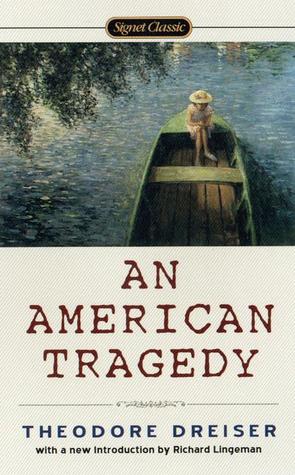
Hundred Book Challenge #12: "An American Tragedy" by Theodore Dreiser

This was the first book in the Hundred Book Challenge that felt like a chore. I didn’t hate it exactly but every word was a special kind of torture to get through. The end result was like the end of a long workout. I know it was good for me but I can’t say I enjoyed the process or am likely to do it again.

“An American Tragedy” is a laborious book. The author, Theodore Dreiser goes into an almost mental patient’s level of description.
A fictional example? Let’s say you wanted to say, “The man paid 50 cents for an apple.” In “An American Tragedy” the sentence would read as follows:
And inasmuch as the man, given to the natural inclinations of all men, at the end of his day of labors- though such labors were not physical in nature, still he expended not an inconsiderable amount of energy- found himself to be in want of some manner of physical needs to build up not only nutrition and a general feeling of wellbeing, but also the act of trading part of one’s hard-earned pay for something else. This magical alchemy of commerce allowed the man to…” and so on.
Someone might have a lot of fun creating a computer program that Dreiserizes sentences.
The story follows Clyde Griffiths, a young man who wants to improve his station in love and life. The tragedy is that his drive ends up destroying the lives of those around him. The story meanders around his life following him from his youth where he was the son of evangelical parents who would, to the embarrassment and frustration of Clyde, street preach. He eventually moves on to other things as he seeks employment and love in areas he feels represents a higher station.
Ultimately he finds himself working in a management position at his rich uncle’s shirt collar factory.  He seduces one of the poor factory girls and gets her pregnant while falling in love with a rich socialite.
Spoiler alert: He ends up murdering the poor factory girl. He gets caught almost immediately, sits through an extended trial where his is found guilty, goes to prison and  is executed.
The story is a tragedy but what makes it an American tragedy? Published in 1925, the points of the story, if not the writing, are very contemporary. This tragedy could only happen in America because they are based on American goals and cultures. A mixture of puritanical religious fervor mixed with the concept of the right to economic and social improvement.
It’s all pretty much sad and depressing. The characters in this novel believe in higher purposes but are driven by base and materialistic desires.
At the same time, the story takes hard looks at various social issues, most prominently the troubles faced by single women who find themselves pregnant. How women at the time had absolutely no option and no future. No one would support them, no one would help them and no one would even recognize them as human. This book is best when it examines this and other truths that modern audiences would find hard to believe while forced to admit that, yes, things aren’t too different. Like reading a horror story and realizing its closer to reality than you are comfortable with.

Like a plate of lima beans or a bottle of kale juice, this book has important qualities, I just couldn’t get past the taste and texture.

Monday, May 5, 2014

This is a stupid, hypocritical, trite video- and that's good news.


This video is stupid, hypocritical, trite and totally misses the point

My eyes are not big enough to roll them in sufficient disgust over this ridiculous video.
A fourth-rate poem which delivers a self-important, self-indulgent message that, by its very nature, is hypocritical.
I also can't overstate how awful I think this poem is just on a basic level. 
This is the type of self-serving BS that makes the Internet worse. It's not saying anything new or worthwhile. All it's doing is giving people a chance to feel smugly superior to when compared to people- often the young generation- who are living life just a little different than you did when you were a kid.
Let's ignore the fact that this poem decries the very technology and devices that is making it viral in the first place. That's too easy. 
Here are some facts about teenagers and college students today, obviously the target of this video. First, 80 percent of them have a job while going to school. That is the largest percentage The United States has ever seen. They also participate in extra curricular activities at a higher rate than ever before, they are graduating at a higher rate than ever before and are completing college at rates higher than ever before all while somehow glued to their phones and social media.
What about relationships? Well, since the advent of smart phones, the divorce rate has gone down significantly when compared to any time post 1975- in other words any time after women were no longer considered property. 
Now I realize this is correlation and not causation- but still relationships appear more healthy now than any time in human history. This means that while we can't say smartphones and the Internet have had a positive effect on marriage, we can categorically say it has not had a negative effect on it. 
So, regardless of the insipid sing-songy poem that indicates you checking your email on the street will cause you to miss out on wife, daughter, granddaughter, everything is just some paranoid fellow's fever dream of a horrific future that just won't come to pass.
Here's the deal. Every advancement in technology or communication has brought this type of asinine commentary. You can find similar complaints about video games, comic books, TV, movies, radio and all the way back to the printing press. The common thread in every instance is they've all been wrong. Humans adapt and our ability to communicate and be part of the world has only increased.
Guess what? When my son was born I was able to share it with my parents and in-laws through the magic of my iPad. I was able to let way more people take part in the joy of that day than any generation previous to me because of the Internet and smartphones. My family routinely engage in huge group texts that allow us to follow in real time our various exploits. It brought my group of friends and family closer together, not further apart.
If the “poetic” git in the video doesn't get it, then he's doing life wrong, not just social media.
Now I suppose it is possible to feel isolated in our modern world- but who the hell cares? It's been possible to feel isolated in every period of history. Some of the best literature illustrates this.
Oh... by the way, kids are reading more books now they any point since the 1960s. Probably thanks to Harry Potter.

The bottom line is don't get caught on the wrong side of an argument that History and modern realities have already proved to be wrong. We aren't missing out on life because of smartphones. We are getting more out of it.